tom
September 27, 2016

Connected Vehicles: Paving The Way For IoT On Wheels

By Tom Dibble

Connected Vehicles

From cars to combines, the IoT market potential of connected vehicles is so expansive that it will even eclipse that of the mobile phone. Connected personal vehicles will be the final link in a fully connected IoT ecosystem. This is an incredibly important moment to capitalize on given how much time people spend in cars. When mobility services and autonomous cars begin to take hold, it will become even more critical as people will be behind a screen instead of behind the wheel.

Industrial equipment and mobility solutions may prove to be even larger and more lucrative than the consumer side. McKinsey & Company says that by 2025, IoT will have an economic impact up to $11 trillion a year, and that 70 percent of the revenue IoT creates will be generated from B2B businesses. In the connected vehicle world, industrial applications will likely follow this trend.
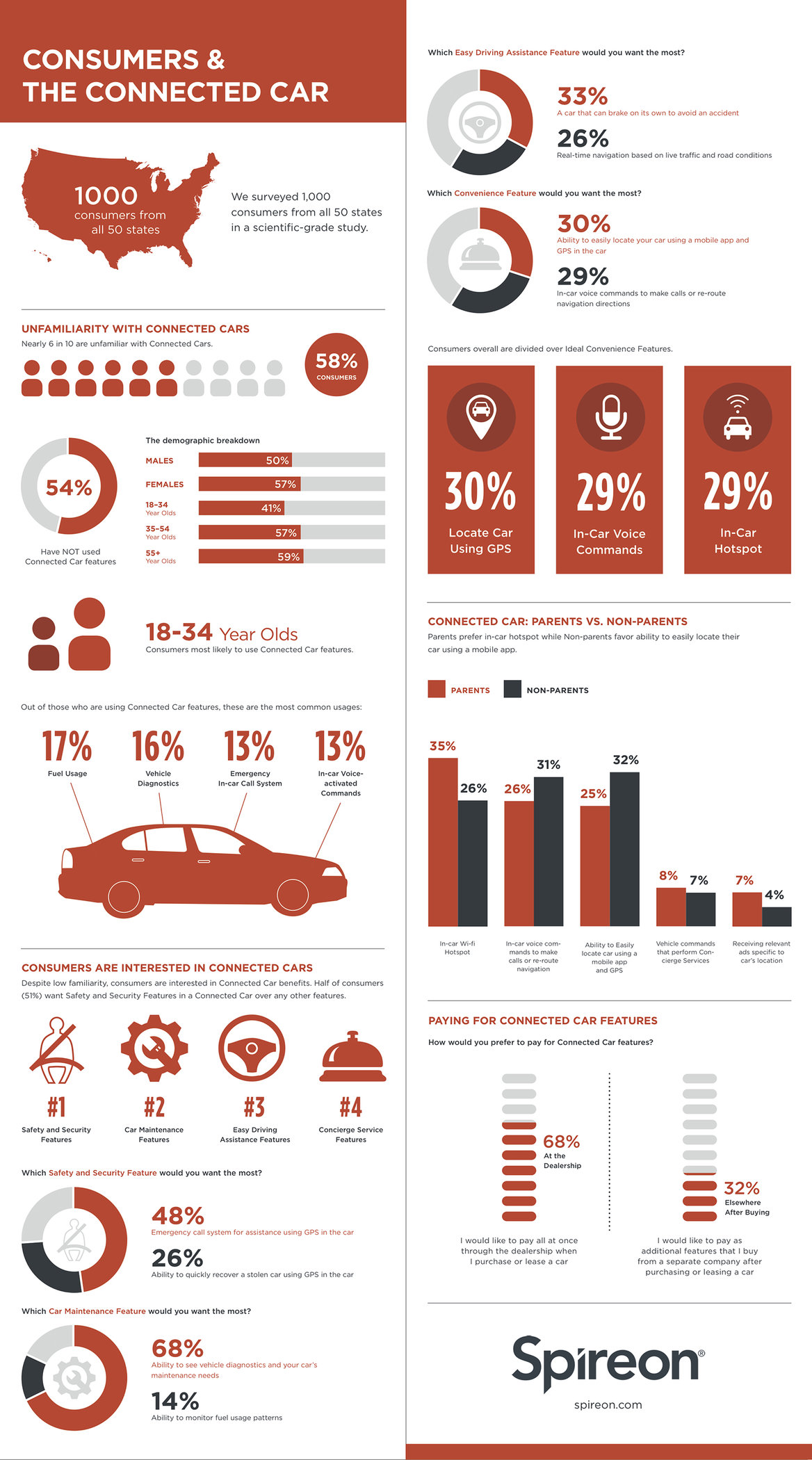
gps_vehicle_tracking_infographic_full

(Infographic source: Spireon)

Technologies like GPS, telematics services, on-board computers, specialized sensors, internet connectivity, and cloud-based data stream management are all fairly mature. The challenge businesses are facing now is how all this technology can be interconnected and used to monetize IoT services in connected vehicles.

To get started, here is a framework for understanding the connected vehicle space—from consumer to industrial offerings. I’ve outlined challenges and opportunities associated with the various business models and lessons learned from other markets to offer guidelines, best practices, and guardrails to maximize the chances for commercial success.

What are the offerings?

The number of individual connected car services that are available or coming to the marketplace is large, but we can place them in four basic categories:

  • Transportation as a Service – Any alternative to traditional sale or lease of a vehicle that requires some amount of connectivity in order to work. Examples: peer-to-peer car sharing, multi-entity (group) leasing, and fleet subscriptions.
  • Post-Sale/Lease Secondary Services – Services offered to vehicle owners/lessees after initial vehicle acquisition. Examples: entertainment delivery, driver experience personalization, roadside assistance, mapping and geo-fencing, human-assisted services like on-demand concierge parking, and intelligent preventive maintenance subscriptions.
  • Road Use Measurement Services – Services directly based upon telematics-sourced data streams. Examples: usage-based insurance, road-use-based taxation, and commercial fleet tracking and management.
  •  Secondary Data Stream Monetization – The analysis of individual driving habits and patterns.

Examples: personalized discounted insurance promotions, or data for to third parties.

What should you do next?

Although these use cases appear to be vastly different from one another, there are some common themes and guidance which can be gleaned from them.

Here are next steps for any connected car industry player:

  • Get your Data House in Order – The connected car depends on data streams produced by sensors and devices, but knowing everything about a person’s driving can be dangerous in malicious hands, so stringently secured systems and policies must be put into place. Some data is vehicle-specific and other data is individual-specific, and different data will need to go to different places, so companies need to deploy sophisticated data management systems that can handle an ever-shifting ‘many-to-many-to-many’ landscape of identity management. Savvy organizations will put systems in place at the outset in order to ‘future-proof’ themselves and lay the groundwork for market agility and consumer safety.
  • Embrace Your Data – If you have access to data, even when it has no apparent direct influence on how you choose to charge for your offering, retain it anyway. Insights are always available via analysis of the consumption patterns of users, but only if you keep the data in an organized, centralized, accessible place. Knowing how users consume a service allows you to stay nimble in a market that is guaranteed to constantly shift and change.
  • The Money Isn’t in the ‘Thing’ – In the IoT world in general, many businesses realize too late that the true monetization opportunity lies NOT with the physical ‘thing’ itself, but rather with the virtual perpetual service that it unlocks. Companies like Jawbone, GoPro, and FitBit all learned this the hard way. Recurring, perpetual services provide an ongoing linkage to a customer that cannot be achieved via any one-and-done sales model, and build an annuity for the enterprise that keeps on giving and doesn’t require constant reinvestment in costly customer acquisition.
  • Learn to ‘Count the Beans’ Differently – Connected vehicle services, like any IoT-based services, lend themselves readily to recurring revenue business models which are measure by fundamentally different KPIs than the one-time-sale model. Profit margins in recurring revenue models are often not fully realized at point of sale, but with a ‘long tail’ of annuity-style profit once margin has been reached. The lessons learned by OEMs years ago when many also became direct lenders are the best analog for recurring revenue success available to them. OEMs should consider housing their connected car strategies within their lending arms for this reason.
  • Take Engineers Out of the Equation Where You Can – Agility and speed to market are of paramount importance in the connected car world. Organizations that show a willingness and ability to get to market quickly, even if imperfectly, and to aggressively pursue multiple simultaneous monetization strategies knowing that not all will succeed—these will be the organizations that ‘win’ in the connected car space.
  • Prepare Back-Office Systems – Unfortunately, especially for mature enterprises like OEMs that have developed dependencies on legacy back-office systems, existing infrastructure was not built to rapidly support new offering models like recurring revenue. More modern (usually cloud-based) back-office systems offer not only dramatically shorter implementation timelines than legacy or home-grown systems, but also put the power of innovation and change in the hands of business users rather than engineers.

The Clearest True North—Connected Vehicles

The obsession with the cult of cars is understandable, but the truth is that there are many segments of “IoT on Wheels” that are moving quickly towards full-on connectedness.

Like many subsets of the IoT (e.g. wearables, connected home) consumer applications for connected personal vehicles get all the hype, but the business applications are really demonstrating the most traction.

Whether B2B or B2C, there is no magic formula for exactly how to make money in the connected vehicle space, however, we are sure to see fascinating changes occurring in the transportation landscape in the coming years. There is hardly anything as captivating, and potentially profitable, as the emergence of IoT on wheels.

Who are the main players?

General Motors

So who are they? There are many systems and vendors that belong in the back-office stack and are required to make a connected car initiative successful. The following represents lead players who are already on the front line, offering monetized connected car services of all types to a growing market.

  • Original Equipment Manufacturers (OEMs) – The actual makers of vehicles themselves stand front and center in the connected car world, arguably better positioned than anyone to realize secondary monetization potential from a captive audience with high propensity for brand loyalty. Examples include household names: General Motors, Audi, BMW, Subaru, Caterpillar, and Komatsu, and John Deere.
  • Third-Party Device Manufacturers – These devices often connect to vehicle systems using the existing capabilities of On-Board Diagnostic (OBD) ports, which have been mandated since 1996. Along with the connectivity offered by WiFi, cellular networks and Bluetooth, this group includes entities offering everything from aftermarket telematics devices to personalization and safety systems like Verizon Hum, and mobile phones themselves. Ubiquitous mobility providers Google and Apple loom heavily within this broad group of players determining how exactly to stake their ground.
  • Third-Party Service Providers – Included here is any service provider that is largely agnostic to a car or the device’s manufacturer. Insurance and maintenance providers are perhaps the most well-known members of this group. However, the broadest definition of this category also includes any service not directly offered by OEMs or third-party devices themselves: the popular Waze mapping app and the fleet management service offered by companies like WEX are two examples.

Where are the opportunities and challenges?

Below are some high-level challenges and opportunities, with some real-life examples:

OEMs Monetizing Transportation as a Service

  • Opportunities – Viable opportunities differ depending on the exact OEM and the exact TaaS model. For example, luxury brands such as Audi, BMW, and Bentley are best positioned to offer services which benefit from brand affinity and prestige. OEMs with a broader install base and lower ASPs are better positioned to benefit from models like group, and peer-to-peer sharing models (e.g. the “airport sharing” component of Ford’s new Ford Pass offering).
  • Challenges – Existing system infrastructure for selling/leasing cars was designed for no more than two names on a title or lease and must be dramatically enhanced or replaced. Managing vehicle inventory for subscription or on-demand access requires fleet management strategies and systems that must be tightly tailored to individual marketplaces, in terms of geography, demographics, and days/times. Effective and comprehensive fleet management direct to consumers, perfected by entities like Zipcar, remain elusive to OEMs entering the game, and will require a significant amount of trial-and-error — potentially resulting in the disintermediation of the entrenched dealer networks.

Aftermarket Device Manufacturers Monetizing Secondary On-Board Services

  • Opportunities – Most cars on the road now (and for a few years to come) do not benefit from OEM-provided connected services, but are being driven by consumers who will demand them nonetheless in what can be called a ‘retrofit’ model. Due to both the long lifespan of vehicles and the extensive amount of time it takes any OEM to go from concept to production, the aftermarket is inherently positioned to be far more agile and much faster to market. Aftermarket devices are far more natively bound to drivers than to vehicles, so the services can move from one car to another as desired.
  • Challenges – OEMs are natively positioned to deliver these offerings at point of initial sale/lease, even to the point of treating them as ‘loss leaders’ and effectively giving them away in order to incent the vehicle purchase itself, or to make money solely on the accompanying service subscription that enables their ‘embedded’ devices, whereas aftermarket devices require stickiness to encourage an additional purchase and/or relationship on the part of the customer above and beyond what they are already paying for the vehicle.

Third-Party Service Providers Monetizing Road Use Measurement Services

  • Opportunities – Insurance Companies are already leveraging the available data streams from embedded OBD systems to provide usage-based insurance to infrequent drivers (potentially opening up a new market segment), or to reward safe drivers with additional discounts on their premiums. Government entities, suffering from declining fuel tax revenues due to more efficient (and non-fuel-consuming electric) vehicles are looking to compensate with direct taxation models based on actual public road use, using data streams from embedded or ‘add-on’ telematics devices (e.g. the trial ‘OReGO’ program underway in Oregon). Unlike many other on-board services which require an ‘always connected’ or ‘almost always connected’ state in order to work properly, most Road Use Measurement Services work with just intermittent connectivity by using a data ‘store-and-forward’ model, thus removing the cost of and dependency on cellular or satellite network providers.
  • Challenges – Effective market penetration will likely require ‘device agnosticism’, which will in turn require sophisticated data stream management platforms capable of organizing and transforming data from myriad sources and formats. Third-party device manufacturers may opt to offer their own (i.e. proprietary) accompanying secondary services, which may supplant the possibility of a vibrant ‘open’ market in which device-agnostic service providers can play.

OEMs Monetizing Secondary Data Streams

  • Opportunities – The sensors on vehicles can produce data streams that the OEM may choose not to share with third parties. This data may be used to provide ongoing revenue streams to dealers. On a granular level, this data can be used to build driver profiles, which in turn can drive individualized direct marketing efforts for available add-on services, or the suggested purchase of a more suitable next vehicle when the time comes. On an aggregate level, this data can be sold to third parties for subsequent commercial or informational purposes.
  • Challenges – OEMs tend to possess neither the mindset nor the infrastructure required to think and act like purveyors of data, as they are historically purveyors of steel. Consumers are ever more wary of implicit data collection, from a privacy standpoint and a security standpoint.

Regardless of the kind of business or the offerings, all the players are working to create new revenue streams from connected services and monetizing alternatives that are tied to the customer rather than traditional purchasing and leasing streams that are tied to the product. The winners will be the ones that provide the best customer experience.

The road to success has its share of potholes. The biggest ones have little to do with the technology itself but constructing a viable business model (along with processes and supporting technologies) where monetization and recurring revenue streams are profitable.

While we aren’t sure whether the next big buck will come from – inside the vehicle or outside of it – we are clear that the IoT is igniting new and more revenue tracks for the automotive industry. The themes and scenarios offered, which are nearly universally applicable across all potential connected car go-to-market efforts, can help the category on their journey towards IoT nirvana.

By Tom Dibble

Tom Dibble

Tom Dibble

Tom Dibble is President and CEO of Aria Systems, a proven leader with more than 20 years of experience in the high technology market. He joined Aria Systems in 2009 from Oracle Corporation where he served as vice president of worldwide channels and alliances, as a result of Oracle's acquisition of BEA Systems in May of 2008.
Cloudtweaks Comic The Ransom
CloudTweaks Premium Thought Leadership
Become a featured voice in CloudTweaks’ branded Spotlight Interviews, podcasts, and thought leadership series. Elevate your brand, shape industry dialogue, and inspire tech professionals worldwide.
© 2026 CloudTweaks. All rights reserved.